
How Does Festo Mounting Equipment Improve Machinery?
Introduction
In industrial automation, Festo Mounting Equipment helps secure compatible cylinders, drives, sensors, and mechanical accessories in the correct operating position. A carefully selected mounting arrangement improves alignment, supports controlled movement, and protects connected parts from avoidable stress.
Festo groups cylinder mounting elements with piston rod attachments, sensor mounts, linear guides, valve mounting accessories, cushioning parts, and drive-specific components. This allows designers to build a complete installation around the required movement and load.
What Is Festo Mounting Equipment?
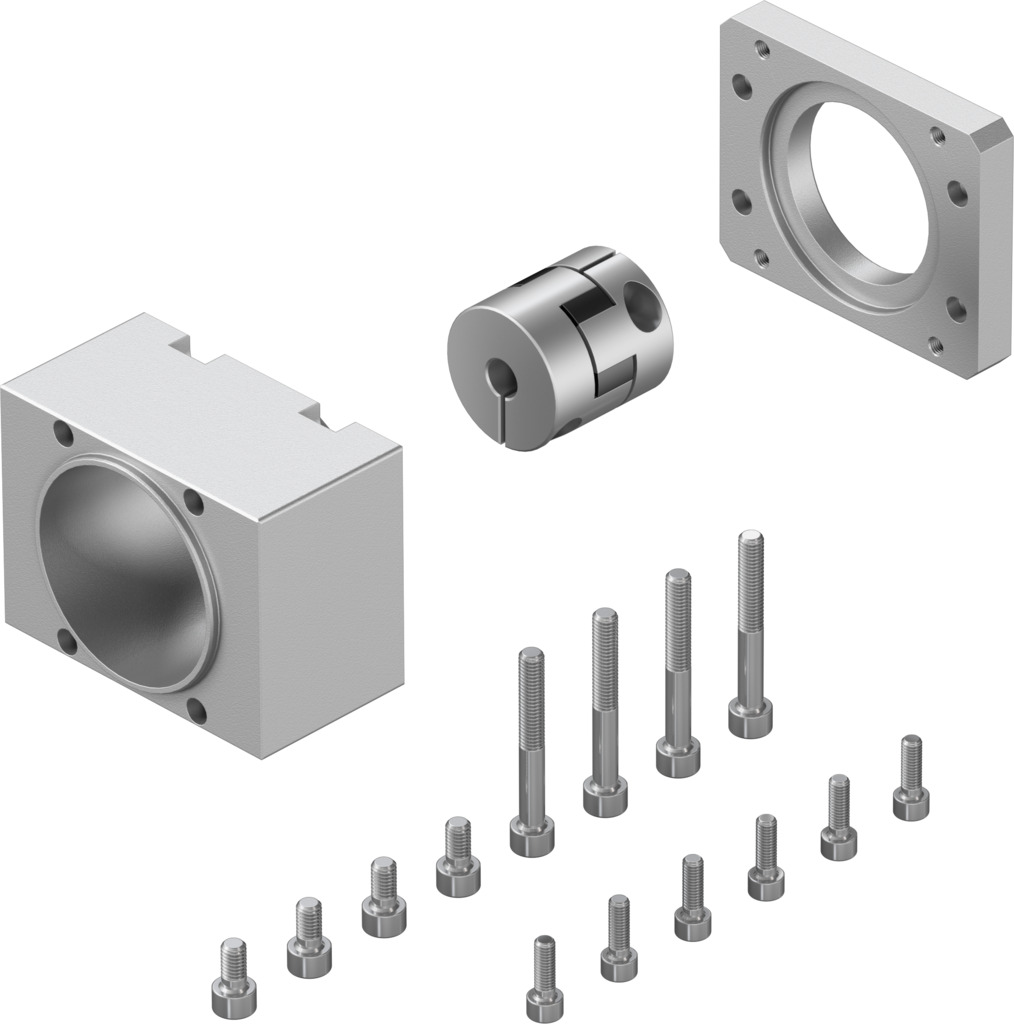
Festo Mounting Equipment includes mechanical parts used to attach an actuator to a machine structure or connect its piston rod to a moving load. Common examples include foot mountings, flanges, swivel brackets, trunnion supports, rod eyes, clevises, and self-aligning couplers.
Fixed mounts hold the cylinder body rigidly, while pivoting mounts allow controlled angular movement as the linkage travels through an arc.
Why Does Correct Mounting Matter?
Pneumatic cylinders generate force along the piston rod axis. If the load sits out of alignment, the rod may experience sideways force, increasing friction, seal wear, and bearing stress.
For frames requiring adjustable structural connections, Threaded Rods & Studs can provide extended fixing points when their diameter, material, thread pitch, and load capacity suit the assembly.
Which Mounting Styles Are Available?
Foot and Flange Mounting
Foot mounts support the cylinder along its body, while front or rear flanges secure it from an end cap. These arrangements suit applications where the actuator remains fixed and drives a load in a straight line.
Festo standards-based cylinders can offer standardised mounting interfaces and broad accessory choices. The exact accessory must still match the cylinder family, size, and product code.
Strong threaded assemblies may use Connecting Nuts to join compatible studding or create extended fastening arrangements within supporting structures.
Swivel, Clevis, and Trunnion Mounting
A swivel or clevis arrangement allows the cylinder to change angle as the mechanism moves. This reduces binding in gates, lifting arms, tilting fixtures, and similar applications.
Trunnion mounting supports the cylinder around a pivot axis positioned on or near the body. Festo documentation lists foot, flange, swivel, clevis, and trunnion options across compatible cylinder systems.
Where compact fastening is required, Socket Screws provide recessed hex-drive fixing options that can suit confined machine locations when correctly graded and tightened.
How Do Piston Rod Attachments Improve Movement?
The piston rod must connect to the load without forcing the cylinder out of alignment. Rod eyes and clevises accommodate pivoting movement, while self-aligning couplers compensate for limited radial or angular deviation.
Festo identifies rod eyes, rod clevises, coupling pieces, and self-aligning rod couplers as accessories for selected actuator families.
Pivot pins may require secure retention during repeated cycling. Suitable Circlip Kits provide replacement retaining components for compatible grooves and shaft sizes during maintenance.
Where Is Festo Mounting Equipment Used?
Assembly and Packaging Machines
Assembly systems use mounted cylinders to clamp parts, position fixtures, operate stops, and transfer components. Packaging machinery uses similar arrangements for gates, guides, sealing mechanisms, and product handling.
A stable mounting system keeps the actuator secure while allowing technicians to reach ports, sensors, and fasteners for inspection.
Pivoting and Guided Mechanisms
Applications with angular motion may use bearing-supported joints to reduce friction and accommodate alignment changes. Correctly selected Plain Bearings can support oscillating interfaces when their load, bore, lubrication, and environmental ratings match the mechanism.
Machines with rotating shafts or adjustable stops may use Shaft Collars to position compatible components and limit axial movement within the wider assembly.
How Should Mounting Equipment Be Selected?
Begin with the exact actuator part number, bore size, stroke, and approved accessory list. Similar-looking mounting parts may differ in hole spacing, thread form, width, pivot diameter, or maximum load.
Engineers should evaluate:
- Load magnitude and direction
- Fixed or pivoting movement
- Available installation space
- Vibration and shock exposure
- Corrosion and washdown conditions
- Access for inspection
- Sensor and tubing clearance
For modular frames, Channel Support Systems can create adjustable structures when the selected channels, brackets, and fixings meet the load and stiffness requirements.
How Should Festo Mounting Equipment Be Installed?
Before installation, isolate the compressed-air supply and secure all moving parts. Check the mounting orientation, hole positions, rod alignment, and full movement path before tightening the assembly.
Good installation practices include:
- Use compatible mounting accessories
- Select fasteners with suitable strength
- Tighten joints evenly
- Keep the piston rod aligned
- Allow pivoting parts to move freely
- Protect tubing and sensor cables
- Test at reduced pressure and speed
After commissioning, inspect for vibration, loose fasteners, harsh impacts, or changing alignment. Early correction prevents minor mechanical issues from becoming actuator failures.
How Can Mounting Reliability Be Maintained?
Routine maintenance should cover brackets, pins, couplers, fasteners, bearings, and the supporting frame. Look for corrosion, cracks, elongated holes, unusual movement, or metallic debris around pivot joints.
Technicians should investigate changes in cylinder speed, noise, or end-position accuracy. Increasing air pressure to overcome mechanical resistance can accelerate wear.
Why Choose Festo Mounting Equipment?
Festo Mounting Equipment helps engineers build stable, aligned, and serviceable actuator installations. Its fixed mounts, pivoting supports, rod attachments, sensor accessories, and drive-specific components support many machine layouts.
By matching every mounting part to the actuator, load, movement path, environment, and machine structure, designers can achieve smoother operation, simpler maintenance, and dependable long-term performance.