
How Does a Festo VUVG 5/3 Solenoid Valve Work?
Introduction
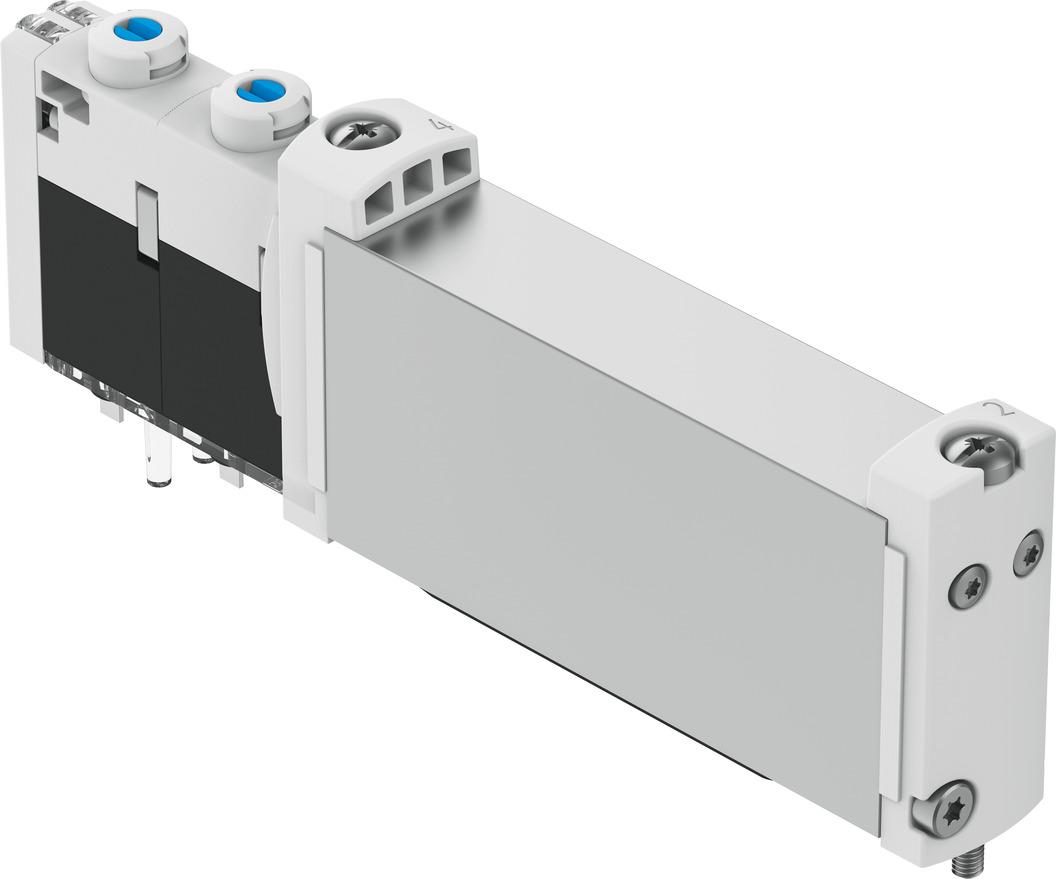
A Festo VUVG 5/3 Solenoid Valve directs compressed air through five ports and three switching positions. It controls extension and retraction in double-acting actuators while providing a centre state that can block, exhaust, or pressurise the working ports, depending on the exact configuration.
This capability suits packaging, assembly, material handling, electronics production, robotic tooling, and testing machinery. Engineers must still confirm the complete VUVG code because centre function, voltage, port size, flow rate, pilot arrangement, and mounting style vary by model.
What Is a Festo VUVG 5/3 Solenoid Valve?
The VUVG is an electrically actuated directional-control valve for compact pneumatic systems. A 5/3 valve has one pressure-supply port, two working ports, two exhaust ports, and three spool positions.
The two outer positions send pressure to opposite sides of an actuator. The middle position determines how the actuator behaves when neither directional solenoid is commanded.
Buyers comparing Pneumatic Solenoid/Pilot-Operated Control Valves should match the pneumatic symbol and centre state to the required machine response.
How Do the Three Switching Positions Operate?
In one commanded position, supply air enters one actuator chamber while the other chamber connects to exhaust. The actuator moves in the first direction.
When the opposite solenoid is energised, the paths reverse and the actuator moves back. When both commands are inactive, the spool enters its centre position.
This three-state behaviour offers more control than a basic 5/2-way valve, especially when a process needs a defined pause, depressurised state, or balanced pressure condition.
Which Centre Function Should You Choose?
A closed-centre VUVG blocks the main ports in the middle position. It can help pause movement, although air compressibility, leakage, and external loading mean it should not be treated as a mechanical lock.
An exhausted-centre version connects the working ports to exhaust. This removes pressure from both actuator chambers and may allow the mechanism to move under gravity or external force.
A pressurised-centre configuration supplies pressure to both working ports. Depending on piston areas and load direction, this can create a balancing condition.
The VUVG range includes closed, exhausted, and pressurised 5/3-way variants. Therefore, the correct option depends on the actuator, load, sequence, stopping requirement, and machine risk assessment.
How Does It Control a Double-Acting Cylinder?
A 5/3 VUVG commonly operates Pneumatic Piston Rod Cylinders by alternating pressure and exhaust between the two cylinder chambers.
Cylinder bore, stroke, load, speed, and cycle frequency determine the required airflow. If the valve or surrounding circuit is undersized, movement may remain slow even when supply pressure appears correct.
Why Do Electrical Connections Matter?
Each solenoid must receive the specified voltage, current, connector arrangement, and controller signal. Incorrect wiring can cause intermittent actuation, overheating, or switching failure.
Compatible Pneumatic Solenoid Coil Connectors support secure integration when their pin layout, protection rating, and cable entry match the selected valve.
Before commissioning, confirm polarity, duty cycle, protective circuitry, and PLC output compatibility.
How Can Position Feedback Improve Automation?
The controller commands the valve, but dependable automation also needs confirmation that the actuator completed its movement.
Suitable Pneumatic Cylinder Sensors can detect piston position and return a signal to the PLC. This supports sequence validation, cycle monitoring, and fault detection.
For example, the controller can prevent the next operation from starting until the cylinder reaches its expected extended or retracted position.
How Do Tubing and Connections Affect Response?
The valve fills and exhausts actuator chambers through tubing and fittings. Long lines, small bores, sharp bends, and restrictive connectors can increase pressure loss and slow movement.
Correctly selected Air Hoses should match the working pressure, diameter, flexibility, temperature range, and installation environment.
Placing the valve closer to the actuator can reduce internal air volume and improve response in fast-cycling equipment.
Why Is a Shut-Off Valve Important?
Removing electrical power does not automatically release pneumatic pressure. A machine may still contain stored energy capable of moving an actuator.
A correctly installed Pneumatic Shut-Off Valve provides a defined upstream isolation point. The system also needs a safe method for releasing downstream pressure and securing gravity-loaded mechanisms.
What Specifications Should Buyers Verify?
Before choosing a Festo VUVG 5/3 Solenoid Valve, confirm:
- Exact 5/3 pneumatic function
- Closed, exhausted, or pressurised centre
- Solenoid and reset arrangement
- Operating voltage and connector type
- Nominal flow capacity
- Working and pilot-pressure range
- Port size and connection method
- Individual or manifold mounting
- Internal or external pilot supply
- Manual override design
- Temperature and protection rating
Festo offers VUVG models in several sizes, pneumatic connection formats, flow ratings, and mounting arrangements. The exact datasheet should guide the final decision because visually similar valves can behave differently.
Where Is the VUVG 5/3 Valve Used?
Common applications include:
- Robotic grippers and end-of-arm tooling
- Double-acting pneumatic cylinders
- Automated clamping mechanisms
- Sorting gates and positioning stops
- Packaging and labelling machinery
- Assembly fixtures and production cells
- Testing and inspection stations
- Material-handling equipment
The valve is especially useful where the centre position forms an important part of the normal operating sequence.
How Should the Valve Be Installed and Maintained?
Install the valve according to its pneumatic symbol, port markings, mounting instructions, and electrical specification. Keep open ports clean and protect cables and tubing from strain, heat, and abrasion.
During commissioning, test all three positions under controlled conditions. Confirm actuator direction, centre-state behaviour, pressure stability, sensor feedback, and exhaust performance.
For maintenance, isolate electrical power, shut off the air supply, release stored pressure, and secure moving loads. Inspect for leakage, contamination, loose connections, damaged wiring, and irregular switching.
Why Choose the Correct Festo VUVG 5/3 Solenoid Valve?
The correct Festo VUVG 5/3 Solenoid Valve provides responsive directional control and a purposeful centre state within a compact automation platform. It can improve process sequencing, actuator management, and machine integration.
Successful performance depends on matching the centre function, voltage, flow, pressure, pilot method, mounting, tubing, sensing, and safety strategy to the application. Careful selection and routine inspection support reliable control across demanding industrial cycles.